
Let’s understand
your orchid.
From its first days to new buds, the care information you need is here.
What’s wrong with my orchid?Get to know your orchid’s parts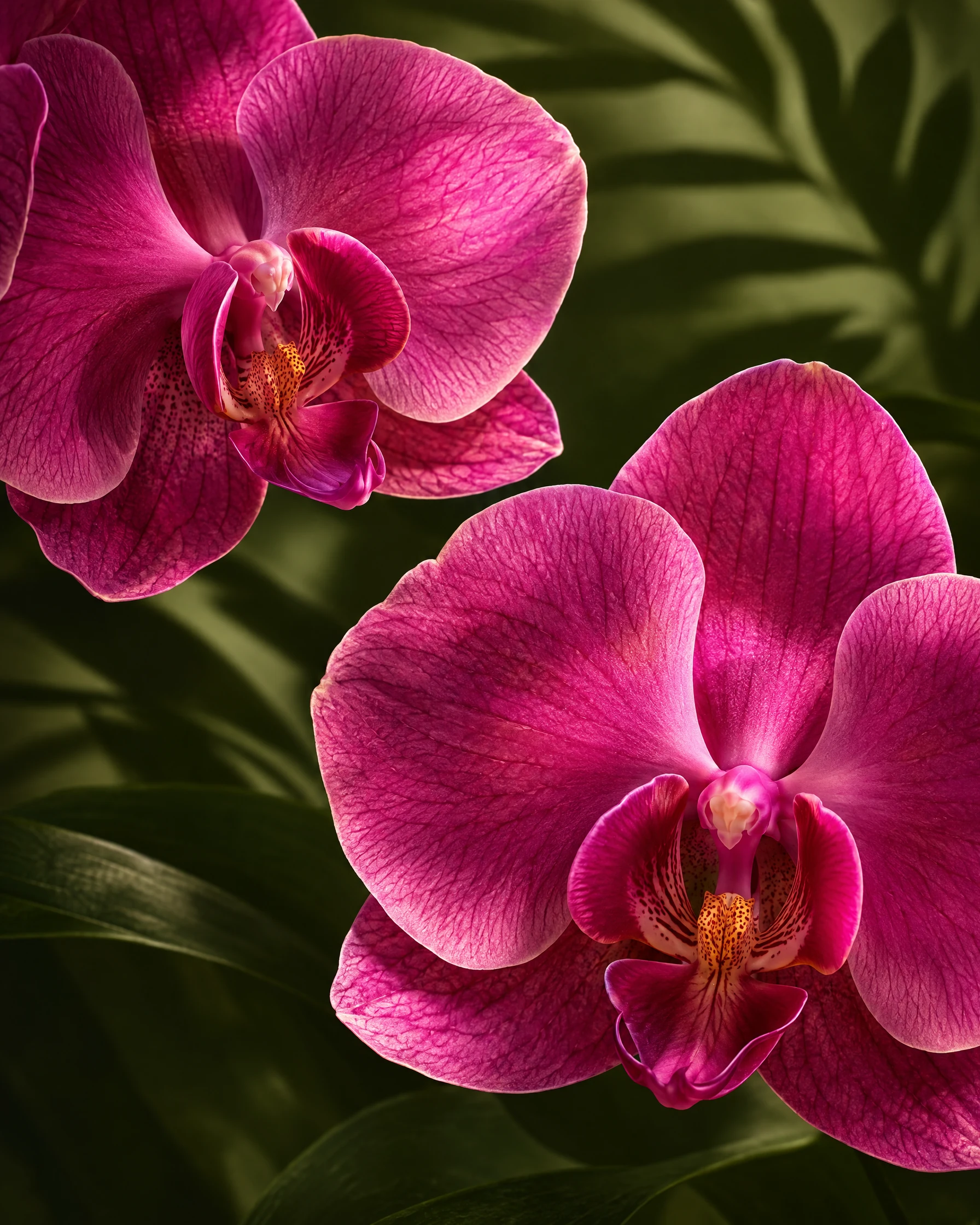
Where shall we start?
Orchid journalThe first days
When bringing your new orchid home and choosing its first spot.
Understanding water
Read the roots and growing medium to find the right time.
The right place
The balance of light, temperature and humidity your orchid needs.
Room for roots
Growing medium, pot selection and step-by-step root care.
Beyond the flowers
Watch the changes, from buds to life after flowering.
A closer look
Recognise the signs you see on leaves and roots.
We know its beauty.
Now let’s get to know it.
A root or a new flower spike? Choose a part, see it closely and learn where to find it on your own orchid.
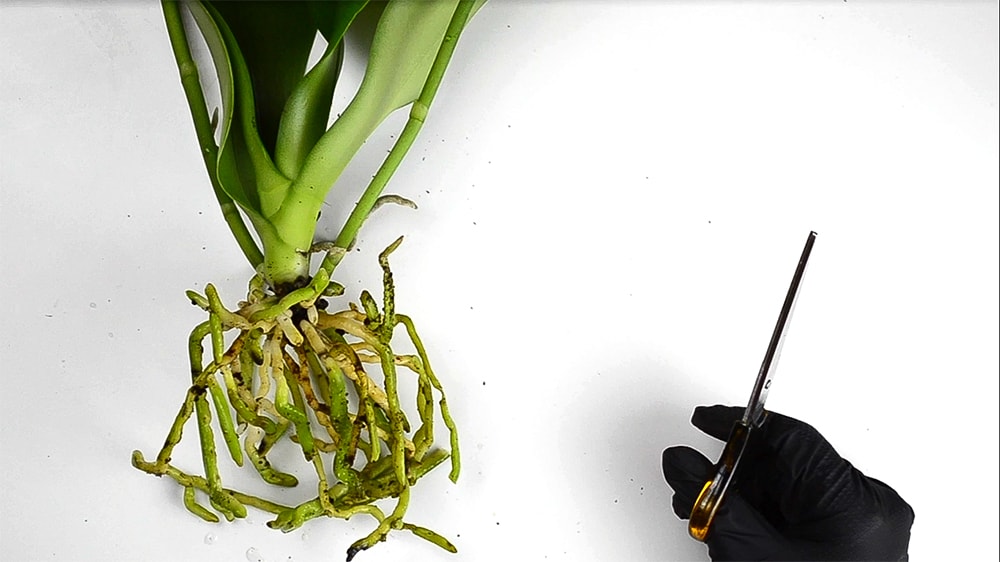
Root
Anchors the plant and takes up water and nutrients.
Thick, cylindrical structures growing from below the leaves. They can grow inside and outside the pot. Their spongy outer velamen layer helps absorb and retain water.
Find it on your own orchid
Aerial roots outside the pot are part of the plant too. New root tips are usually rounded and smooth.
A small care noteDo not use root colour alone to decide on watering; check medium moisture too. Do not cut a healthy root because it has grown outside the pot.
Read the watering guide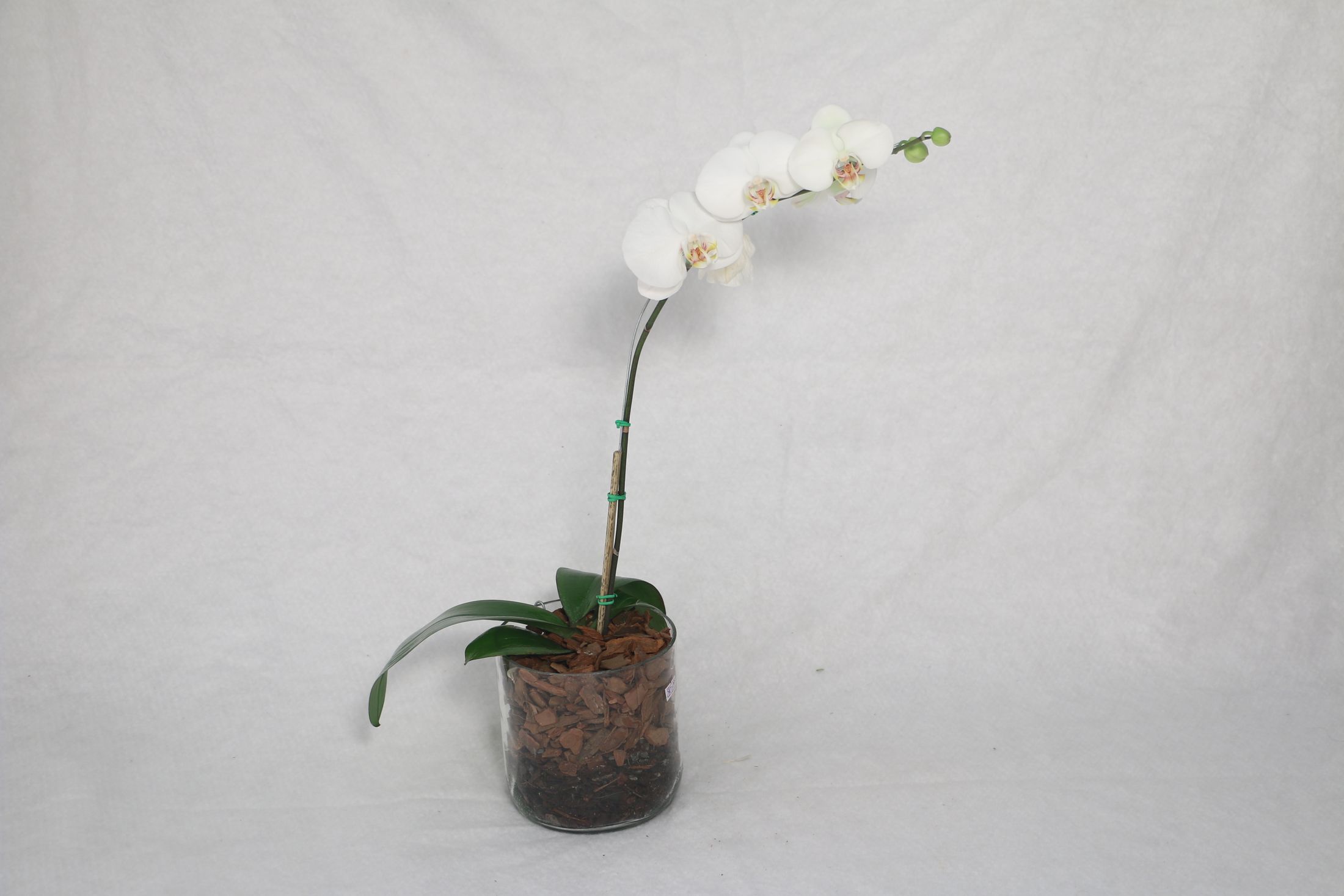
Leaf
The plant’s energy-producing surface.
Phalaenopsis has broad, fleshy leaves extending to either side of its stem. They use light to produce the food needed for growth. New leaves develop at the centre of the plant.
Find it on your own orchid
Look for broad, flat green surfaces immediately above the roots. A small leaf on a flower spike may be the beginning of a keiki.
A small care noteAvoid leaving water in the crown where leaves meet. Consider changes in leaf colour or texture alongside the whole plant’s condition.
Read the light and environment guideFlower spike
Carries the buds and flowers.
This slender shoot, also called the flower stem, emerges between the leaves and carries nodes. Buds, followed by flowers, develop along it.
Find it on your own orchid
Follow the green stem towards the flowers. The straight wooden stick beside it is only a support, not part of the plant.
A small care noteA new root usually has a round tip; a new flower spike may have a flatter tip resembling a little mitten. Watch very young shoots develop to tell them apart.
Read the pruning guide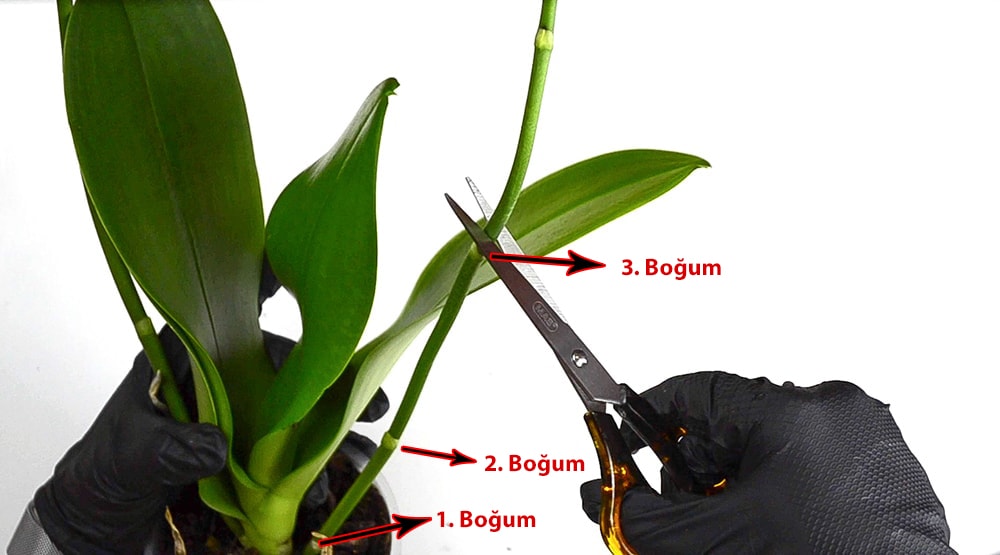
Node
A small growth point on the spike.
A small bump or joint-like section on the flower spike. It contains a bud protected by a thin sheath. In suitable conditions, a side spike or keiki may develop from this point.
Find it on your own orchid
Follow the spike from bottom to top, looking for spaced bumps and their sheaths. Clips holding the plant are not nodes.
A small care noteNot every node produces a new spike. Do not remove a node or its protective sheath; decide on pruning according to the spike and plant’s condition.
Read the pruning guideBud
A flower that has not opened yet.
A closed flower developing near the tips of the flower spike. It becomes fuller as it grows and may look green or coloured depending on the variety. Flower parts remain protected inside until the petals open.
Find it on your own orchid
Look for small, round or oval closed structures at the spike’s tip. A bud has no leaves or roots; if these develop, it may be a keiki.
A small care noteDo not force buds open. If you see yellowing, shrivelling or falling, assess watering, light and sudden environmental changes together.
Read the bud-care guideFlower
An opened bud.
Phalaenopsis has three sepals and three petals that create its butterfly-like appearance. One petal forms the prominent, often differently coloured lip in the centre.
Find it on your own orchid
Find the coloured lip in the centre of an open flower. The spike carrying the flower is different from the main stem where the leaves meet.
A small care noteFlowers reaching the end of their life and falling do not alone mean the plant has died. Continue observing leaves and roots too.
Read the first-care guide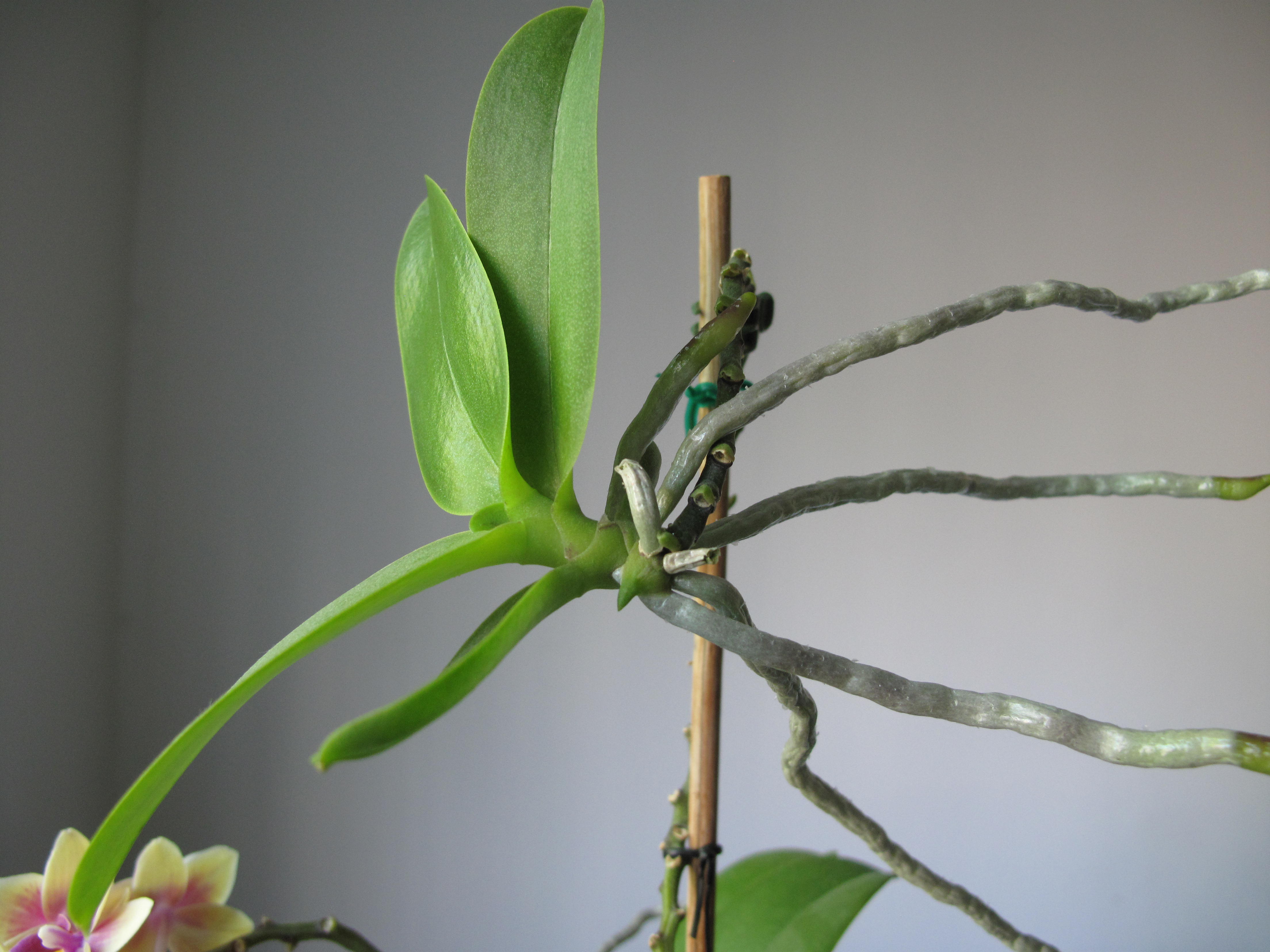
Keiki
A baby orchid growing on the parent plant.
A small plant that can develop from a node on the flower spike. It may form leaves first, then its own roots. The photograph shows a keiki with developed leaves and aerial roots.
Find it on your own orchid
Look for a small cluster of leaves and roots on the flower spike. Not every orchid produces a keiki; its absence is not a problem.
A small care noteA bud or a new side spike is not the same as a keiki. Do not try to separate the young plant before its own root system develops.
Review changes in your plantInformation and image sources
These definitions refer to Phalaenopsis. Botanical information: American Orchid Society · Orchid parts, flower spikes and nodes, keiki; University of Maryland Extension · Distinguishing roots and flower spikes. Photos: Solo Plant’s existing website and care archive; keiki photo by Tangopaso / Wikimedia Commons (public domain). Close-up crops are displayed on the page.
Care guides
1 care guides · İlk bakım
Small care notes.
At your fingertips.
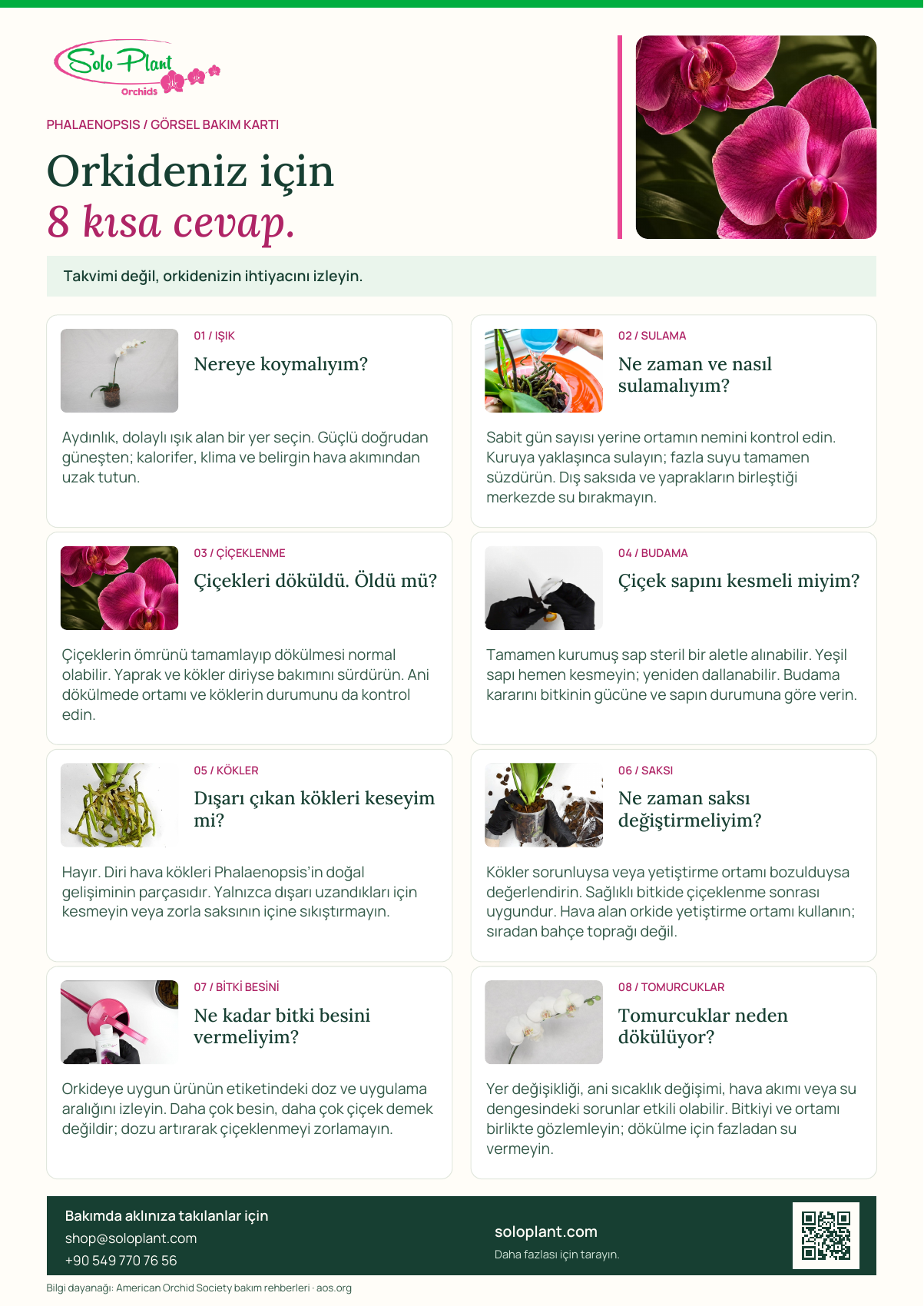
When should you water? What should you do after flowers fall? Should you cut roots growing outside the pot?
We’ve collected short answers to eight common questions on a single page. Save it, print it or give it to someone together with your orchid.
A4 · 1 page · Turkish PDFDownload care card (Turkish PDF)View PDF (Turkish)Tell us what you see.
Let’s take a look together.
Choose changes in flowers, leaves and roots to find relevant care guides.